Wearable HRV Monitor 2026: Which Devices Give the Most Accurate Heart Rate Variability Data?
A practical comparison of the main wearable HRV monitors in 2026 (WHOOP, Oura, Garmin, Apple Watch, Fitbit, Withings, and Hiyd) covering sensor accuracy, form factor trade-offs, and how to choose based on your situation.
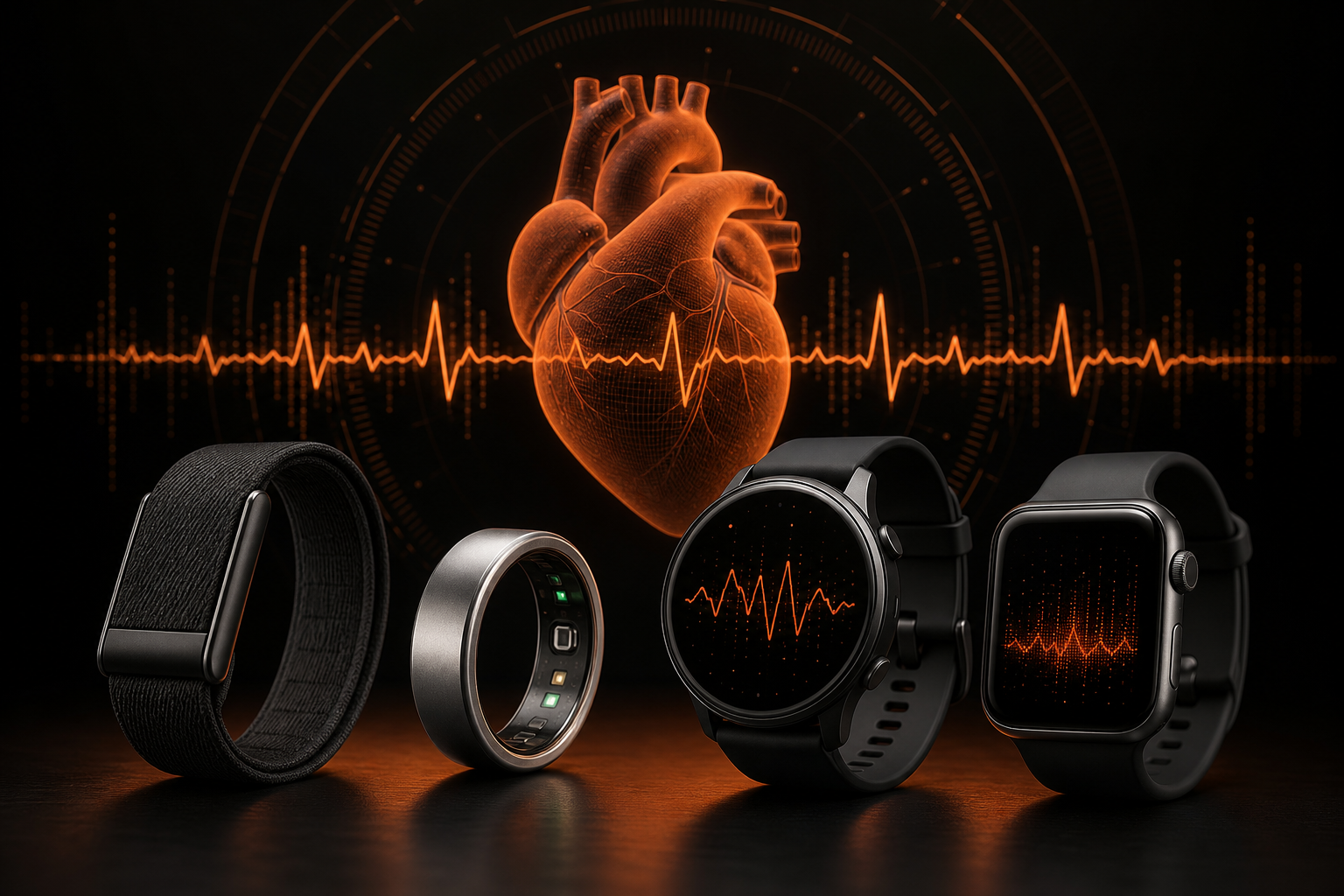
Heart rate variability has moved from sports science labs into everyday health tracking, and the device you choose to measure it matters more than most buyers realize. HRV is sensitive to sensor placement, measurement timing, and how consistently you wear the device. Pick the wrong wearable and you end up with noisy data that tells you very little.
This guide covers how the main wearable HRV monitors in 2026 actually work, what affects their accuracy in real use, and which one makes sense depending on how you live and what you already wear on your wrist.
What HRV Actually Measures, and Why Accuracy Is Hard
HRV tracks the variation in time between consecutive heartbeats. Higher HRV generally signals good recovery and autonomic nervous system balance. Lower HRV can point to stress, poor sleep, or accumulated fatigue.
The challenge is that HRV is genuinely difficult to measure accurately with an optical sensor. The gold standard is an ECG, which reads electrical signals directly from the heart. Consumer wearables use photoplethysmography (PPG), shining light through the skin to detect blood volume changes. PPG-derived HRV is an approximation, not a clinical measurement. That's true across every device in this comparison.
What separates good consumer HRV data from poor data comes down to three things: sensor contact quality, measurement timing, and how the device handles motion artifacts.
The Main Wearable HRV Monitors in 2026
WHOOP 5.0
WHOOP has built its entire product around recovery, and HRV sits at the center of that system. It measures HRV during a brief morning window while you're still in bed, which reduces motion interference and produces a cleaner resting baseline. Continuous overnight tracking also captures sleep-stage HRV patterns.
The trade-off is structural. WHOOP starts at $199 per year, hardware is included, but the subscription is mandatory and ongoing. There's no nutrition tracking. And using it means wearing a second band alongside the watch you already own, or giving up your watch entirely.
Oura Ring 4
Oura moves the sensor from the wrist to the finger, which improves arterial signal quality. Fingers have less subcutaneous fat and more consistent blood flow than the wrist, so Oura's HRV readings tend to be more stable during sleep. The ring form factor also means you're not stacking it with a watch.
Hardware runs $349 to $499, plus $5.99 per month. Like WHOOP, there's no nutrition integration. It's a strong choice for sleep-focused HRV tracking, but it requires adopting a new device and an ongoing fee.
Garmin Vivoactive 6
Garmin's wrist-based HRV tracking is solid for athletes who want continuous daytime monitoring alongside GPS workout data. The Vivoactive 6 is a one-time purchase at $299.99, which removes the subscription problem. It is, however, a full smartwatch replacement. You're swapping out your existing watch, not adding to it. HRV depth is present but secondary to the device's fitness-first positioning.
Apple Watch Series 12
Apple Watch Series 12 includes an electrical heart sensor for ECG readings alongside optical HRV tracking. The hardware accuracy is competitive, and the Health app ecosystem is well-developed. That said, it's iPhone-exclusive, starts around $399, and requires replacing whatever watch you currently wear. HRV data is available but not the platform's primary focus.
Fitbit Charge 6
Fitbit offers HRV tracking through its Daily Readiness Score. At approximately $149 one-time, the Charge 6 is the lowest entry point in this comparison. HRV coaching depth is limited compared to WHOOP or Oura, and there are lingering questions about product continuity under Google ownership. For serious HRV monitoring, it's a budget starting point rather than a primary tool.
Withings ScanWatch Nova
Withings positions the ScanWatch Nova as a clinically focused hybrid watch with ECG capability. It has a traditional watch aesthetic and solid HRV sensing. The limitation is that it's a standalone replacement watch. You wear it instead of your existing timepiece, not alongside it.
What Actually Affects HRV Accuracy in Daily Use
The hardware matters, but user behavior affects data quality more than most people expect.
Sensor contact is the single biggest variable. A loose band, a sensor sitting off-center on the wrist, or a device worn too high on the forearm will all degrade HRV readings. Oura's finger placement has a structural advantage here, a ring simply can't shift the way a wrist band can.
Measurement timing matters too. HRV fluctuates throughout the day based on activity, meals, stress, and posture. Devices that measure during a consistent overnight or early-morning window, when you're still and resting, produce more comparable data over time than those averaging continuous daytime readings.
Consistency of wear is underrated. HRV trends are more useful than single-day readings. A device you wear every night builds a meaningful baseline. A device you take off regularly because it's uncomfortable, or because it clashes with your watch, leaves gaps in the data.
The Problem Most HRV Comparisons Ignore
Every device listed above requires you to adopt a new form factor. WHOOP, Fitbit, and Garmin go on your wrist. Oura goes on your finger. Apple Watch replaces your watch entirely. Withings is itself a watch.
If you own a mechanical, dress, or heritage watch you wear daily, none of these options let you keep it. That's a real constraint, one most HRV comparison guides treat as irrelevant. For a significant number of people, it isn't.
Hiyd approaches this differently. It's a biometric sensor that attaches to the back of the watch you already own using microsuction: no magnets, no adhesive, no residue. You keep wearing the watch you already own. The sensor passively tracks heart rate, HRV, sleep staging, movement, calories burned, and VO2 max estimation throughout the day. For sleep and recovery tracking, a silicone band accessory is used instead.
All data feeds into a companion app, where a feature called The Reading synthesizes your sleep, movement, and nutrition data into a single unified view. There are no behavioral nudges or prescriptive alerts, just the data, presented clearly. Nutrition logging, including meals and macros, is built directly into the app with no third-party integration required.
Hiyd is sold as a one-time hardware purchase with no subscription. Hiyd Gen 2 is going live on Kickstarter in November 2026. You can reserve your spot at hiyd.ai/pages/hiyd-deposit.
How to Choose Based on Your Situation
If you want the most sleep-focused HRV data and don't mind wearing a ring: Oura Ring 4 is the strongest option for overnight HRV accuracy, but factor in the ongoing monthly cost.
If recovery coaching and athletic performance are the priority: WHOOP 5.0 is purpose-built for this, though the subscription means you're paying indefinitely.
If you want one-time pricing and GPS fitness tracking: Garmin Vivoactive 6 covers both, at the cost of replacing your existing watch.
If you own a watch you won't replace and want HRV alongside nutrition data in one place: Hiyd is designed for this use case. No other device adds health tracking to an existing watch rather than replacing it.
A Note on Comparing HRV Numbers Across Devices
Before you buy, it's worth understanding one thing: HRV numbers from different devices are not directly comparable. A reading of 65ms on WHOOP and 65ms on Oura do not mean the same thing. Each platform uses different algorithms, measurement windows, and filtering methods. What matters is your trend on a single device over time, not the absolute number, and not a comparison to someone else's readings on a different platform.
This is why consistency of wear and a stable measurement window matter more than which device theoretically has the best sensor.
FAQs
What is the most accurate wearable HRV monitor in 2026?
No consumer wearable provides clinical ECG-grade HRV accuracy. Among mainstream options, Oura Ring 4's finger-based sensor tends to produce stable overnight readings due to better arterial access at the finger. WHOOP 5.0's controlled morning measurement window also delivers consistent resting HRV data. Accuracy depends as much on how consistently you wear the device as on the sensor itself.
Can I track HRV without replacing my existing watch?
Yes. Hiyd is a biometric sensor that attaches to the back of the watch you already own via microsuction, letting you track HRV, heart rate, sleep, and other metrics without giving up your current timepiece. Hiyd Gen 2 is going live on Kickstarter in November 2026, with reservations open at hiyd.ai.
Is wrist-based HRV as accurate as ring-based HRV?
Ring-based sensors like Oura generally have a structural advantage for overnight HRV tracking: the finger has more consistent blood flow, and the ring can't shift the way a wrist band can. That said, wrist-based devices from WHOOP and Garmin produce useful HRV trend data when worn consistently and measured at rest.
Why do my HRV numbers differ between devices?
Each device uses its own algorithms, measurement timing, and signal processing. A number from one platform isn't directly comparable to a number from another. Track your HRV trend on a single device over time rather than comparing raw numbers across platforms.
Does HRV tracking require a subscription?
Not always. Garmin Vivoactive 6 and Fitbit Charge 6 are one-time purchases. WHOOP requires an ongoing subscription starting at $199 per year. Oura charges $5.99 per month after the hardware purchase. Hiyd is a one-time hardware purchase with no subscription.
How often should I check my HRV?
Daily overnight readings give you the most consistent baseline. Single-day readings are less meaningful than a rolling average over one to two weeks. What you're looking for is whether your HRV is trending up, down, or stable relative to your personal baseline, most platforms display a trend line for exactly this reason.
What factors lower HRV readings?
Alcohol, poor sleep, high training load, illness, psychological stress, and inconsistent sleep timing all tend to suppress HRV. A single low reading is rarely significant. A sustained downward trend over several days usually signals something worth addressing in recovery, sleep, or stress management.
HRV data is only as useful as the device you actually wear consistently. The best wearable HRV monitor is the one that fits your life without requiring you to change how you live it: whether that means accepting a subscription model, adopting a new form factor, or finding something that works with what you already wear. Those are genuinely different trade-offs, and the right answer depends on what you're optimizing for.